Services

Full-spectrum delivery. One AI-powered operating model.

From product design and MVP through to enterprise modernisation, cloud migration, and agentic SDLC — every engagement built around measurable outcomes your team owns after we leave.

01 / Core offers

Full-spectrum delivery. One AI-powered operating model.

Each engagement area is built around measurable outcomes — architecture choices, AI workflows, and platform changes your team owns after we leave.

Enterprise Application Modernisation

Migrate legacy monolithic platforms to cloud-native architecture without full rewrites or delivery stalls — across Java, Python, Node.js, and .NET stacks.

  • Strangler-fig and parallel-run migration patterns
  • Zero-downtime cutover planning
  • Language-agnostic API-first decomposition across Java, Python, Node.js, and .NET
  • Compliance-safe refactoring under uptime pressure
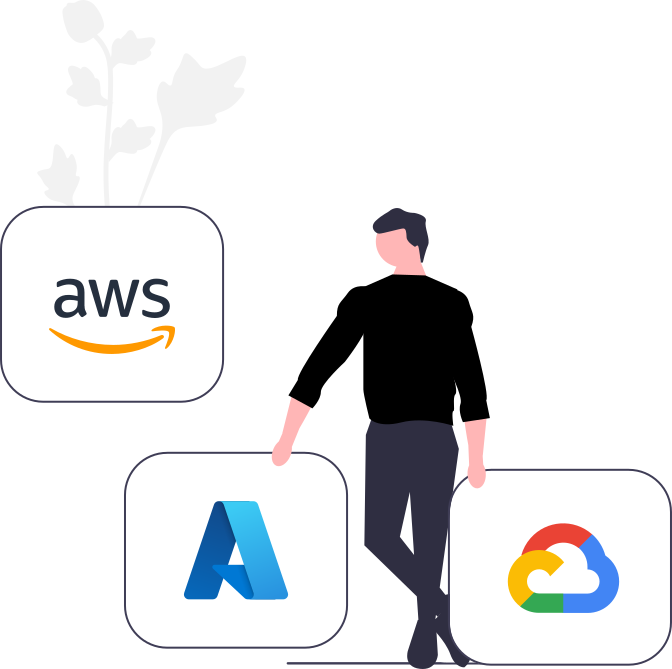
Cloud Migration & DevOps

End-to-end cloud migration and resilient DevOps foundations across AWS, Azure, and GCP — from landing zones to live operations.

  • Landing zones and infrastructure-as-code (Terraform, Bicep)
  • Kubernetes design, migration, and operations
  • CI/CD pipeline automation and GitOps
  • Cloud cost optimisation and uptime engineering

AI Enablement

Production AI within 90 days — LLM integration, RAG pipelines, and AI agents with enterprise governance built in from day one.

  • LLM and RAG pipeline architecture
  • AI agent and copilot development
  • Prompt governance, audit trails, and observability
  • Model evaluation, fine-tuning, and cost controls

Application Development

Web and mobile applications built for enterprise scale — Angular, React, Flutter, React Native, and .NET MAUI with API-first backends.

  • iOS and Android with Flutter, React Native, and .NET MAUI
  • Angular and React web platforms with SSR
  • SEO-ready architecture and Core Web Vitals
  • Offline-first, real-time, and scalable backend APIs

Data Migration & ETL

Structured data migration, pipeline engineering, and ETL modernisation for enterprise data platforms — with zero-loss validation.

  • Legacy database and data warehouse migration
  • ETL and ELT pipeline design and delivery
  • Real-time streaming (Kafka, Event Hubs) and batch processing
  • Data quality validation, reconciliation, and lineage

QA & Security Engineering

Shift-left quality and security embedded across the delivery lifecycle — automated testing, penetration testing, and compliance-ready hardening.

  • Automated testing strategy and execution (unit, integration, E2E)
  • SAST, DAST, and penetration testing
  • Security hardening and compliance checks (OWASP, SOC 2)
  • Quality gates embedded in CI/CD pipelines

Agentic Software Development (ADLC)

We embed an agent-first development mindset into your engineering culture — from AI-native IDEs and LLM coding assistants to autonomous review, test generation, and delivery workflow automation.

  • LLM coding assistant integration: Claude Code, GitHub Copilot, and OpenAI Codex across your IDE and terminal workflows
  • Agentic CI/CD: AI-generated tests, automated code review agents, and intelligent deployment gates
  • Engineering team enablement: hands-on workshops, certification support, and embedded mentoring on AI-native SDLC practices
  • Agentic workflow design across planning, coding, review, and incident triage — with human-in-the-loop governance

Product Design

From validated idea to engineering-ready prototype — UX research, interface design, and design systems built for handoff, not just approval decks.

  • UX research, user journey mapping, and information architecture
  • High-fidelity UI design and interactive prototyping
  • Design systems and component libraries aligned with your engineering stack
  • AI-assisted design workflows — faster iteration without sacrificing quality

Product Development

End-to-end product delivery from scoped MVP to production at scale — ADLC-powered sprints with product management, engineering, design, and QA in one coordinated delivery pod.

  • MVP scoping, backlog design, and product-market fit engineering
  • ADLC-powered delivery pods: PM, design, engineering, and QA in one sprint rhythm
  • AI-augmented sprints: requirement distillation, agent-assisted coding, and automated test generation
  • Product analytics, feature flags, and A/B testing infrastructure

Technical Strategy & Advisory

Independent technical guidance from senior engineers — architecture reviews, technology selection, and delivery risk assessment.

  • Architecture & system design reviews
  • Technology roadmap and platform selection
  • Delivery risk assessment & programme recovery
  • Build vs buy analysis for critical platform decisions

03 / AI enablement

AI where it sharpens execution.

Every use case targets a real delivery constraint — not a proof of concept. We measure AI adoption by its impact on throughput, decision speed, and time-to-production.

AI in production

AI applied to real delivery constraints

Every use case below targets a bottleneck that slows enterprise delivery. We measure AI adoption by throughput improvement, not demo count.

Code review and technical debt

Code review and technical debt

Challenge: Legacy codebases accumulate technical debt faster than manual review cycles can address, blocking modernisation sprints.

AI approach: AI-assisted code review identifies dead code, anti-patterns, and upgrade blockers across the codebase before engineers touch it.

Expected outcome: 40% reduction in review cycle time. Modernisation sprints start with a clean, scoped target instead of a discovery phase.

Incident triage and root cause analysis

Incident triage and root cause analysis

Challenge: Cloud operations teams spend 60–70% of incident response time correlating logs and alerts across distributed systems.

AI approach: AI classifier ingests logs, traces, and alert streams to surface the probable root cause and affected blast radius within minutes of an event.

Expected outcome: Mean time to acknowledge drops by 60%. On-call engineers diagnose faster and escalate less.

Requirements distillation

Requirements distillation

Challenge: Product teams lose one to two days per sprint translating stakeholder documents and meeting notes into structured user stories.

AI approach: AI processes transcripts, specs, and Confluence pages to output draft acceptance criteria, story maps, and dependency flags for engineer review.

Expected outcome: Sprint planning time halved. Engineers spend planning sessions on edge cases and sequencing, not drafting from scratch.

Data pipeline anomaly detection

Data pipeline anomaly detection

Challenge: Silent ETL failures and data drift go undetected for hours or days, corrupting downstream reports and triggering compliance events.

AI approach: AI monitors pipeline throughput, schema drift, and value distributions in real time, alerting before bad data reaches the warehouse.

Expected outcome: Data incidents caught in minutes, not days. Compliance team confidence in report accuracy without manual reconciliation runs.

04 / Implementation

A phased path, not a big-bang programme.

Each phase has defined outputs and a clear handoff point. You keep delivery control at every stage.

Implementation path

Implementation roadmap

A modular delivery sequence that lets teams validate architecture choices, product risk, and operational readiness in the same program.

~16 weeks · 4 months
Phase 1: Discovery (Week 1)
01

Phase 1: Discovery (Week 1)

  • Audit data sources and workflows
  • Select two pilot use cases
  • Define KPIs and success targets

Output: Prioritized AI backlog with measurable outcomes

Phase 2: Pilot (Weeks 2-4)
02

Phase 2: Pilot (Weeks 2-4)

  • Ship one workflow per team
  • Keep human-in-the-loop approvals
  • Instrument adoption and quality metrics

Output: Working pilot with baseline vs. AI-assisted results

Phase 3: Integration (Weeks 5-8)
03

Phase 3: Integration (Weeks 5-8)

  • Connect CRM, ticketing, and analytics stack
  • Apply access control and audit logging
  • Document prompt and model governance

Output: Secure production integration with governance controls

Phase 4: Scale (Ongoing)
04

Phase 4: Scale (Ongoing)

  • Automate retraining and prompt updates
  • Roll out to additional departments
  • Run monthly KPI reviews and tuning

Output: Cross-functional AI operating model

Next step

Turn a delivery constraint into a scoped plan.

Tell us which platform, AI, cloud, or product delivery problem matters most. We will help identify the highest-leverage starting point.